What Does It Mean for a Series to Converge
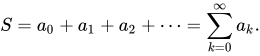
In mathematics, a series is the sum of the terms of an infinite sequence of numbers. More precisely, an infinite sequence defines a series S that is denoted

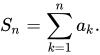
The n th partial sum S n is the sum of the kickoff due north terms of the sequence; that is,
A series is convergent (or converges) if the sequence of its partial sums tends to a limit; that means that, when adding one after the other in the order given by the indices, i gets partial sums that become closer and closer to a given number. More precisely, a series converges, if there exists a number such that for every arbitrarily small positive number , in that location is a (sufficiently large) integer such that for all ,



If the series is convergent, the (necessarily unique) number is called the sum of the serial.
The aforementioned notation

is used for the series, and, if it is convergent, to its sum. This convention is similar to that which is used for addition: a + b denotes the operation of calculation a and b besides as the issue of this addition, which is chosen the sum of a and b.
Any series that is non convergent is said to be divergent or to diverge.
Examples of convergent and divergent series [edit]
Convergence tests [edit]
There are a number of methods of determining whether a serial converges or diverges.
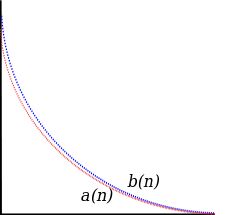
If the blueish series, , tin be proven to converge, so the smaller series, must converge. By contraposition, if the blood-red series is proven to diverge, so must also diverge.


Comparison exam. The terms of the sequence are compared to those of some other sequence . If, for all n, , and converges, then then does





Withal, if, for all northward, , and diverges, then so does

Ratio examination. Presume that for all n, is not nil. Suppose that there exists such that


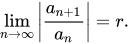
If r < ane, so the series is absolutely convergent. If r > 1, then the serial diverges. If r = i, the ratio test is inconclusive, and the series may converge or diverge.
Root test or northwardthursday root test. Suppose that the terms of the sequence in question are not-negative. Ascertain r every bit follows:
![{\displaystyle r=\limsup _{n\to \infty }{\sqrt[{n}]{|a_{n}|}},}](https://wikimedia.org/api/rest_v1/media/math/render/svg/50ec31fb14ea99381af3e9507f8d415088f39a51)
- where "lim sup" denotes the limit superior (perhaps ∞; if the limit exists it is the aforementioned value).
If r < 1, then the series converges. If r > 1, then the series diverges. If r = 1, the root test is inconclusive, and the series may converge or diverge.
The ratio examination and the root examination are both based on comparison with a geometric series, and as such they work in like situations. In fact, if the ratio examination works (meaning that the limit exists and is not equal to one) then so does the root test; the antipodal, withal, is not true. The root test is therefore more mostly applicable, but equally a practical affair the limit is often difficult to compute for commonly seen types of series.
Integral test. The series tin can be compared to an integral to constitute convergence or departure. Let exist a positive and monotonically decreasing function. If


then the series converges. But if the integral diverges, and then the series does and then also.
Limit comparison test. If , and the limit exists and is non cipher, and then converges if and only if converges.



Alternating series test. Also known as the Leibniz benchmark, the alternating series test states that for an alternating series of the grade , if is monotonically decreasing, and has a limit of 0 at infinity, then the series converges.
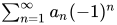
Cauchy condensation test. If is a positive monotone decreasing sequence, and then converges if and only if converges.

Dirichlet's test
Abel's test
Conditional and absolute convergence [edit]
For whatsoever sequence , for all n. Therefore,


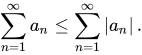
This ways that if converges, then as well converges (but not vice versa).

If the series converges, then the series is absolutely convergent. The Maclaurin serial of the exponential function is admittedly convergent for every complex value of the variable.
If the series converges but the series diverges, and so the serial is conditionally convergent. The Maclaurin serial of the logarithm office is conditionally convergent for x = one.

The Riemann series theorem states that if a series converges conditionally, it is possible to rearrange the terms of the series in such a style that the series converges to any value, or even diverges.
Uniform convergence [edit]
Let be a sequence of functions. The series is said to converge uniformly to f if the sequence of partial sums divers by



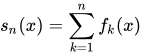
converges uniformly to f.
There is an analogue of the comparison test for infinite series of functions chosen the Weierstrass M-test.
Cauchy convergence criterion [edit]
The Cauchy convergence benchmark states that a series

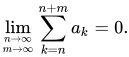
converges if and simply if the sequence of partial sums is a Cauchy sequence. This means that for every there is a positive integer such that for all we have


which is equivalent to
See also [edit]
- Normal convergence
- List of mathematical serial
External links [edit]
- "Series", Encyclopedia of Mathematics, European monetary system Printing, 2001 [1994]
- Weisstein, Eric (2005). Riemann Serial Theorem. Retrieved May 16, 2005.
Source: https://en.wikipedia.org/wiki/Convergent_series
0 Response to "What Does It Mean for a Series to Converge"
Post a Comment